
Beatriz Milhazes: Biography and Work: Style, Influences, and Global Recognition
Beatriz Milhazes: Biography and Work: Style, Influences, and Global Recognition
Article Index
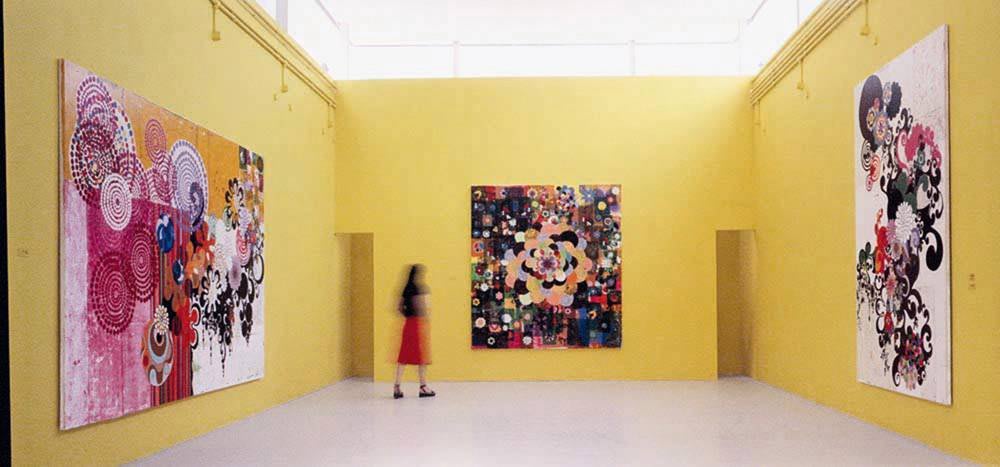
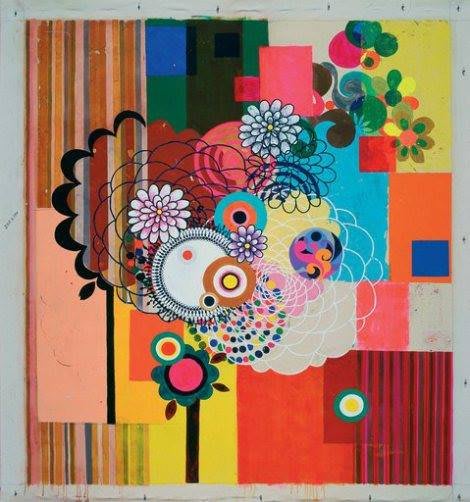
The main elements in Beatriz Milhazes' works are the diversity of colors and geometric shapes in various iterations, whether in collages, paintings, or overlays.
Beatriz has a waiting list for her artworks, yet she remains true to her creative process, producing a maximum of seven canvases per year, each meticulously planned.
According to her: “Without color, the image doesn't happen. When the symphony of colors doesn't work, the allure fades.”
From 2002, the artist began incorporating straight lines into her work, explaining: "I consider myself a geometric artist. I always wanted to create a kind of visual tour, something with intensity and movement that had no center or stopping point. And that's where the circle came from. It embodies infinity, never-ending. But just as you can make a circle stop, you can make a straight line move. Based on this reasoning, in 2002, I introduced stripes into my work. It's the form I found with the greatest potential to continue this ‘circular movement.’ Now, I'm starting to make squares and stripes dialogue with the circles."
In 2003, Beatriz Milhazes made her international debut at the Venice Biennale, showcasing her vibrant color palette in one of the most significant international exhibitions.
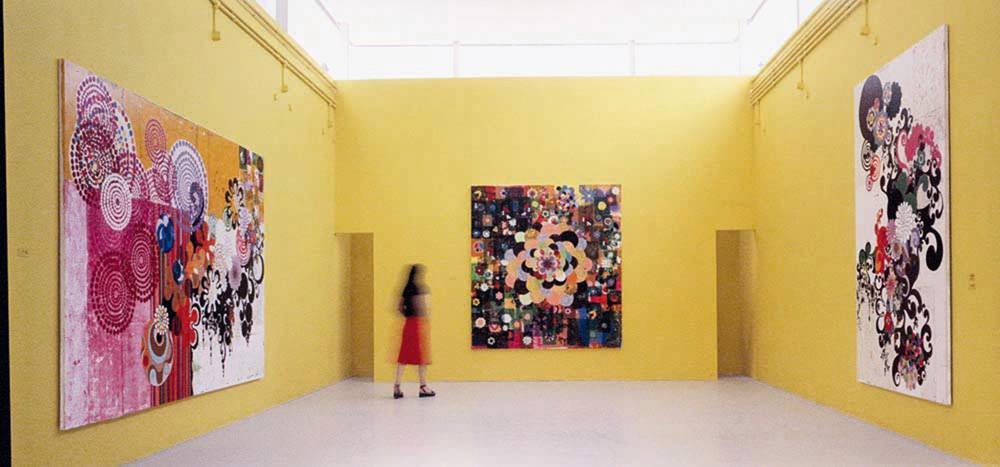
In addition to the aforementioned Venice Biennale, she also participated in the São Paulo Biennial in 2004 and the Shanghai Biennale in 2006. Some of her works are also held in important museums across Europe and the United States.
She has held exhibitions at the Museo Nacional Centro de Arte Reina Sofía in Madrid and the Metropolitan Museum of Art (MOMA) in New York.
Milhazes’ international recognition mirrors the path of other iconic figures who transformed the Brazilian abstract landscape. Tomie Ohtake - Biography and Art: A Journey from Immigration to Abstraction
Influences
Beatriz Milhazes' work is deeply rooted in the international language of modernism, while also firmly grounded in her own place and time.
She defines her style as "Abstract Geometric." The artist sees her work as related to Antropofagia (Anthropophagy), a movement that is part of Brazilian modernism, emerging with the famous work of Tarsila in 1928, whose meaning is linked to cannibalism – the concept that Brazilian artists appropriate foreign elements and digest them to produce something personal.
This cultural dialogue is a central theme among artists who bridged the gap between Latin American expression and global artistic shifts. Surrealism: A Global Artistic Movement and Contemporary Artists
Beyond the modernist painter Tarsila do Amaral, she also drew influences from Piet Mondrian, Henri Matisse, Baroque Art, Art Nouveau, and Art Deco. Her desire was to incorporate all of these into her work, but always grounded in a strong composition.
Yet, it is evident that nothing quite like her work has ever existed in Brazilian art, past or present. Beatriz Milhazes stands unparalleled.
Her unique approach to geometry is part of a broader history of Brazilian creators who revolutionized the concept of contemporary art. Hélio Oiticica and His Main Works
"Painting, too, has an enormous past. Virtually the entire history of art is built upon painting. So, innovating is more challenging today. That's precisely what interests me." - Beatriz Milhazes.
Legacy
To understand the rest of this journey, continue to our next article: Beatriz Milhazes: Biography and Work: Notable Works and Artistic Legacy.


